

Image from Jessica Brady CEDAR Trust
This blog post highlights a tool which people based in England who are struggling for a diagnosis with their GP can consider raising as part of a constructive, shared patient-doctor decision making discussion. We hear from many via our helpdesk that so many patients are dismissed if they try to discuss more than one symptom. They tell us they leave appointments feeling unheard. They are refused additional tests which might help clarify an answer to their symptoms. Whilst we have every sympathy for the busy GP in today’s challenging times, by sharing information about this important rule we hope it helps patients to remind all healthcare professionals, whatever country they are in, that sometimes taking a step back and re-evaluating, is a vital part of any journey.
Navigating the road to a correct diagnosis can be an incredibly frustrating experience. For many in our community, it takes months, or even years, of repeated doctor’s appointments to finally discover that Pernicious Anaemia is the root cause of their exhausting symptoms.
That is why we want to highlight a crucial NHS primary care initiative in England that every single one of our members should know about: Jess’s Rule.
What is Jess’s Rule?
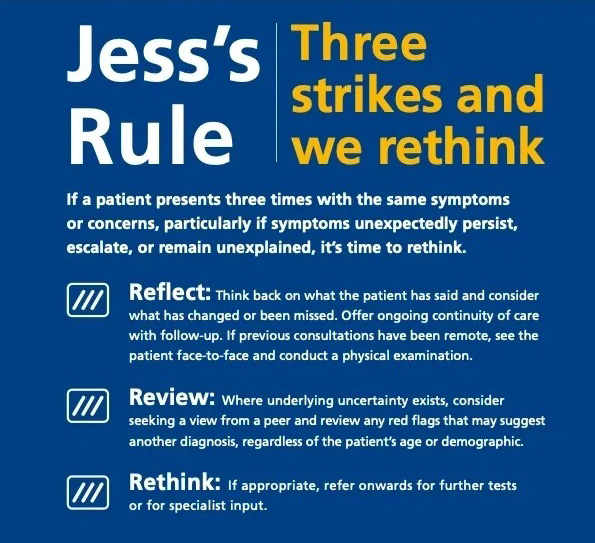
Jess’s Rule is a patient safety initiative backed by NHS England and the Department of Health and Social Care. It introduces a formal framework requiring General Practitioners (GPs) to “reflect, review, and rethink” a case if a patient presents three times with the same, worsening, or unresolved symptoms without a clear diagnosis.
The rule is named in memory of Jessica Brady, a 27-year-old who tragically died of advanced cancer after her repeated symptoms were unhappily dismissed as minor issues. Her family’s tireless campaigning led to this system-wide change, ensuring that nobody else faces the same barriers to being heard.
How the “Three-Appointment” Rule Works
When a patient triggers Jess’s Rule by attending a third appointment for the same unresolved issue, GPs are required to take a “fresh eyes” approach using a clear three-step method:
- Reflect: The GP must actively consider what might have been missed. If previous consultations were held remotely (over the phone or online), the doctor should offer an in-person, face-to-face appointment and a thorough physical examination.
- Review: The clinical team must check for underlying “red flag” indicators—regardless of how young or healthy the patient might seem—and discuss the case with fellow clinical peers to get an objective second opinion.
- Rethink: The GP is expected to escalate the care plan. This means ordering more specific diagnostic blood tests or formally referring the patient to a specialist.
Why this Matters for the Pernicious Anaemia Community
Because the symptoms of Pernicious Anaemia—such as profound fatigue, brain fog, breathlessness, and tingling nerve sensations—are often non-specific, they are frequently misattributed to stress, lifestyle, or other common conditions during initial consultations.
Jess’s Rule gives you a concrete, official mechanism to break the cycle of repetitive, dead-end appointments. If you have seen your GP three times and feel you are still going round in circles without a diagnosis, or without proper care for new or returning symptoms, this rule empowers you to explicitly ask for a formal review.
Advocating For Yourself: Keep a clear log of your symptoms, track dates of your appointments, and if you are in England, do not hesitate to remind your practice of Jess’s Rule if your symptoms remain unresolved after three visits. You have the right to a fresh clinical perspective.
Elsewhere, bringing the principles of Jess’s Rule to your doctor might also make them Reflect, Review and Rethink.
Navigating Pushback
We know from the experiences shared by our members that introducing new frameworks into a busy GP surgery isn’t always easy. You may experience some pushback; doctors may point out that guidelines and rules are not rigid laws they are legally forced to follow, and they will rightly want to protect their own clinical judgment.
This is exactly where the Pernicious Anaemia Society (PAS) can help you to help yourself. By presenting your symptoms, the precise tests you need, and the treatments you want in a highly structured way, you can work with that clinical judgment rather than against it. Bringing along clear information and research that is already fully approved by the NHS—such as official NHS guidelines and British National Formulary (BNF) protocols—massively increases your chances of getting a clear outcome. It transforms a difficult conversation into an efficient, collaborative, and incredibly good use of time for both you and your doctor.
Resources and Next Steps
To help support your doctor in this process, you can find excellent, dedicated training resources on the Jessica Brady CEDAR Trust website: Jess’s Rule – Training for GPs. By sharing these evidence-backed tools alongside your PAS symptom logs, you can empower both yourself and your clinical team to find the answers you deserve.



I agree that Jess’s rule is an excellent idea. But for me it probably still would not have helped as the biggest red herring was that my serum B12 blood test was “normal”. This was after two years of misdiagnosis, undergoing tests for bowel cancer, being sent to a psychotherapist and being given various drugs including fluoxetine. I only got the correct diagnosis myself as I took myself to the medical library and worked it out myself and got a referral to an endocrinologist. He tested everything and I was strongly positive for parietal cell antibodies but as I said my B12 was normal and they didn’t know how much B12 to give me. I had to ring Martyn Hooper who told me I needed loading doses. I also did not have the “classic” symptoms, no pins and needles, nothing wrong with my tongue.
So no doctor can diagnose without correct diagnostic tools. When I asked the GP to test my homocysteine they said it was not a test they used. No one has yet banned the serum B12 blood test on a health and safety basis despite the great suffering and huge costs to the NHS that that one misleading blood test is causing. My misdiagnosis was between 2006-2008. Twenty years on there is still no good diagnostic tool for B12 deficiency.
I’m going to keep a record of dates and discussions I have with my GP practice as I try to navigate the system.
In February I had an annual blood test which I have had since having a thyroidectomy for Graves’ disease when I was 38, I’m now 72. I had a message from the surgery about a week later and was told I needed another blood test for B12 and foliates.
I had a look on line and found it was a test for pernicious anaemia. I was not given the result of the test and I’ve spent the months since trying to find out about the condition.
In2017 I had an unexplained episode of high blood pressure (220/110)and started on medication for this.
In 2018 I woke to transient confusion and tinnitus in one ear (which I still have every day) I saw an ENT consultant privately and he arranged an MRI scan which showed I’d had a lacuna infarct (type of stroke).
I have had trouble sleeping for a number of years as well
In 2025 I noticed I had mild vitiligo but didn’t see anyone about it, I thought it was just an age issue as I was 71 years old by this time.
In Jan 2026 I noticed my toes and soles of my feet felt a bit numb and the tips of my fingers feel a bit numb at times but had put this down to my age as well.
I have since discovered that these symptoms seem to be suggestive of pernicious anaemia. The more I’ve read the more I’m sure it explains how I’ve been feeling.
Two weeks ago I had a telephone consultation with a doctor at the practice and suggested I may have pernicious anaemia but she said that I couldn’t have it as my B12 level was 503 and my folate level was more than 20. At the time of the blood test I told her I take a multivitamin but she didn’t think that would make any difference to the results. I’m afraid I don’t know enough about the blood results yet to challenge any results but it is my intention to be referred to an endocrine consultant.
I am so grateful that I found this site and feel it’s answered a lot of questions I’ve had lately but I know from reading about others experience that it may take some time to get through to my GP practice.