

Personal Story
Tami -Washington State
“Tami, wake up,” he said softly.
I blinked up at him, mortified. I was juggling multiple jobs to pay for school, so of course I was tired. Wasn’t everyone?
“I’m concerned about you,” he continued. “You’ve been sleeping in class for a while now. Are you getting enough rest?”
I promised him I’d try to stay awake, but his concern lingered. For the first time, I started paying attention to the fatigue that had always been there, how I could nearly drift off at a stoplight, how my hands and feet tingled, how I forgot small things, how even mild exertion left me breathless. I had always assumed I was out of shape or stressed or simply not eating enough greens. At twenty, nothing felt serious enough to warrant alarm.
“Your B12 level is sixty-two,” my doctor said, his voice heavy. “How long have you been feeling like this?”
I didn’t know how to answer. I couldn’t remember a time when I didn’t feel that way.
A battery of tests finally revealed the truth: I had Pernicious Anemia. A bit of digging into my family history uncovered an unexpected thread. My great grandmother had died from the same disease, a familial link I never knew existed.
At first, I went to my family doctor for monthly injections. When it became clear I needed them more often, he referred me to a hematologist who eventually entrusted the weekly injections to my care. I learned to juggle an intramuscular needle and an ampule of cobalamin, steady my hands, take a breath, and push the needle into my own skin. It wasn’t easy at first, but it became an act of taking back control. Once my symptoms were treated consistently, the difference was night and day.
For the first time, I felt what other people seemed to take for granted, clarity, energy, the ability to stay awake through a day without fighting my own biology.
Which brings me to the part of the story that surprises people most.
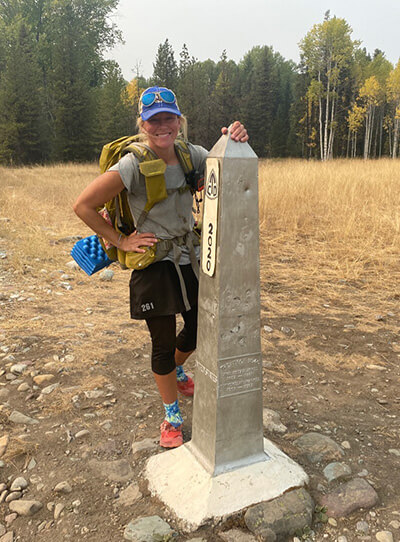
Despite the fatigue, the injections, the digestive complications, and the constant management my condition required, I kept walking. One mile became another, and eventually those miles carried me across the Pacific Crest Trail, the Continental Divide Trail, and the Appalachian Trail. I was 49 when I finished the last one. More than 8,000 miles. Months of daily marathons. Weather that humbled me. Terrain that tested me. And a body that, on paper, should not have been able to do any of it.
The trail did not erase my disease, but rather, it taught me better how to live with it. It instructed me to listen, to fatigue, to hunger, to the subtle signals that my B12 was dipping. It taught me to advocate for myself, to rest without guilt, to adjust my pace without apology. It taught me that strength is not the absence of limitation; it is the decision to move forward anyway.
And it taught me that a diagnosis does not define the size of a life. I was determined to do all the things I wanted without this disease defining me.
Pernicious Anemia is part of my story, but it is not the center of it. The center is that I kept going, even when it meant slowing down, adjusting, or finding a different way through. I learned to manage my condition with discipline and compassion, carrying my injections beside my food and tent, paying attention to what my body needed, and moving forward at a pace that belonged to me. I crossed deserts, climbed mountains, and walked through storms not to prove anything, but to stay connected to the life I wanted, even with a body that asked more of me and offered its own kind of strength in return.
I did not hike the Triple Crown despite my disease. I hiked it with it. And that, to me, is the victory.